Eneco expands partnership with Gradyent to unlock district heating flexibility for energy trading
Eneco, one of the Netherlands' largest energy companies and a pioneer in virtual power plant technology, has deepened its partnership with Gradyent to unlock the full flexibility potential of its heat and energy production and distribution assets in Utrecht. Building on an existing collaboration, Eneco is now using Gradyent's real-time Digital Twin to optimize energy trading and heat and energy production while using Eneco's Myriad Virtual Power Plant (VPP).
Eneco serves around 5 million customers with electricity, gas, and heat, and operates over 10 GW of generation assets – predominantly renewable, spanning wind, solar, heatpumps & e-boilers – across the Netherlands and beyond. Its Utrecht district heating system supplies heat to around 60,000 connected households via a diverse, decentralized portfolio of assets: two combined heat and power (CHP) plants with a combined capacity of over 450 MWe, a biomass heat plant with a capacity of more than 60 MWth, four (decentral) heat pumps – including an aquathermal installation recovering heat from the city's wastewater treatment plant –, two electric boilers, (decentral) gas boilers and five decentralized buffer tanks. These assets are interconnected through a complex hydraulic network, feeding into eight secondary distribution networks and more than 30 circulation pumps.
As a leader in renewable energy trading, Eneco has developed Myriad – the first large-scale operational VPP in the Netherlands – to optimize and trade its portfolio of wind farms, solar parks, batteries, and other flexible assets in real time across energy markets. To add more flexibility to the wider energy system and monetize that on electricity markets, Eneco has now set its sights on making better use of the flexibility from its Utrecht power plants in its trading portfolio, while maintaining the reliability of its district heating system.
The challenge: the gap between commercially optimal and physically feasible schedules
For energy companies operating district heating systems there are big opportunities in managing heat and power as one integrated system. Historically, it has been hard to use the full flexibility as there are margins that need to be maintained to guarantee the reliability of the heating system. These days, the day-ahead schedules that arrive from the trading desk unlock more of the potential flexibility yet are still not always optimal.
In practice, realizing this optimization potential is far from straightforward. While market signals may indicate an economically attractive dispatch schedule, district heating networks operate within a complex set of physical constraints that must be respected at all times. Operators need to account for factors such as network temperatures, hydraulic limitations, heat transport delays, thermal storage levels, asset ramp rates, maintenance schedules, and local bottlenecks throughout the system. This often means that the dispatch schedules are not feasible and need manual adjustments, causing imbalance & leaving value on the table.
As flexibility opportunities in electricity markets continue to increase, the challenge is no longer a lack of data, but rather the ability to continuously translate commercial opportunities into operationally feasible schedules while maintaining reliability and security of supply. This challenge has traditionally forced operators to work with conservative margins, limiting the amount of flexibility that can be safely brought to market.
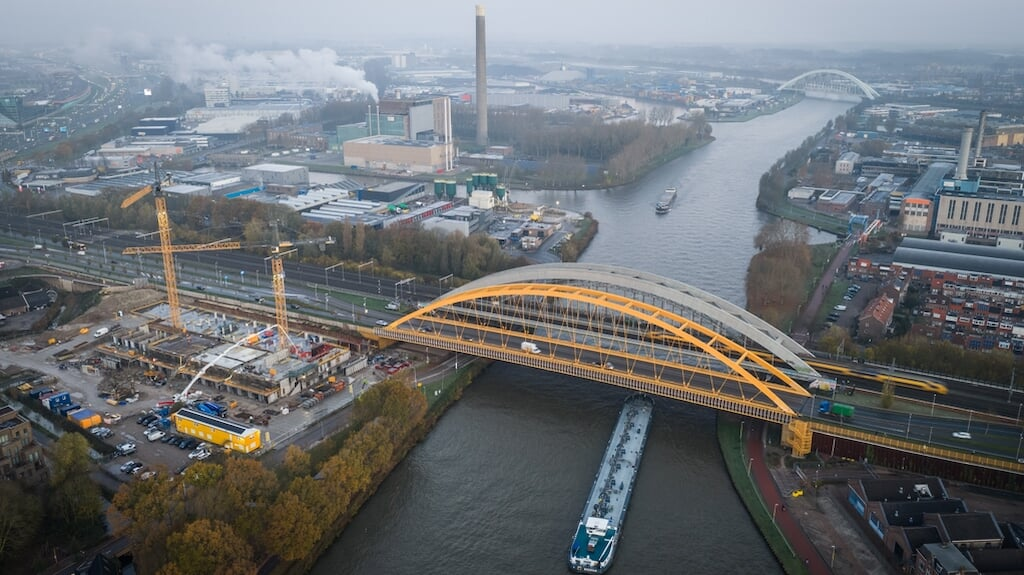 Image: Energy Production Utrecht, Eneco's main heat production location in Utrecht combining a CHP and biomass plant
The Digital Twin to link trading and operations
Eneco – as both energy trader and Balance Responsible Party – selected Gradyent's real-time Digital Twin as the operational backbone connecting its trading ambitions with the physical realities of the Utrecht heating network and power generation.
Gradyent's Digital Twin continuously optimizes the Utrecht system for energy cost and market value – determining which assets to run, at what output, and at what network temperatures, based on real-time electricity prices. Rather than only basing heat production on demand, it integrates electricity markets with real-time network dynamics to determine how production is scheduled, how buffers are charged and discharged, and how the mix of CHPs, gas boilers, heat pumps, and electric boilers is deployed throughout the day.
“What Eneco is doing in Utrecht is a blueprint for the future of how district heating integrates into flexible energy portfolios. In the collaboration between Gradyent & Eneco, the end-to-end Digital Twin at the heart of real-time operations is becoming the missing link between trading ambition and physical network reality. This unlocks value in the trading optimization whilst ensuring that operations do not need to adjust continually”
Hervé Huisman - CEO, Gradyent
Every optimization is grounded in the physics of the network. All thermohydraulics, pipe transport times, actual heat losses, but also buffer dynamics, heat pump and e-boiler ramp rates and efficiency of production assets, are modelled and continuously calculated – updated every 15 minutes across all 13 production and storage assets.
Once a plan is validated, Gradyent's Digital Twin executes it autonomously – locking in optimal charging and discharging schedules for the five buffer tanks, determining temperature setpoints for each substation, and coordinating across all decentralized production assets. Operators monitor the execution of a single, unified plan for the whole system that is synchronized across the full organization. This replaces phone calls and manual adjustment between teams.
The result: Eneco can now better incorporate the flexibility of its Utrecht power and heating system into its VPP portfolio – and thus unlocking new profitability through electricity market participation.
"Flexibility in the energy system is becoming more and more important as the amount of green power increases, and we try to match the moments that we consume power with the moments that green power is available. At Eneco we try to use our assets in the best possible way so that we can maximally leverage the flexibility within. This is good for us, but also for the energy system as a whole, as it helps to match supply and demand of energy. The integration of Gradyent’s Digital Twin into our systems helps us to optimally use the entire Utrecht/Nieuwegein city heating network and the power plants in Utrecht, while maintaining the high reliability that our customers expect.”
Bram Smeets – Director of Flexible Generation & Storage Solutions, Eneco
About Eneco
Eneco is one of the Netherlands' largest integrated energy companies. Eneco Energy Trade is a leading European energy trader and Balance Responsible Party, developing and operating Myriad – the Netherlands' first large-scale Virtual Power Plant – to optimize and trade its portfolio of renewable and flexible assets in real time across day-ahead, intraday, and balancing markets. Eneco has committed to achieving climate neutrality by 2035.
About Gradyent
Gradyent provides a real-time Digital Twin that enables district heating and cooling (DHC) companies to optimize, decarbonize, and future-proof their energy systems end-to-end. By combining physics-based modeling with data-driven intelligence, Gradyent's Digital Twin continuously forecasts and optimizes the full energy system in real time – unlocking flexibility from sources, accumulators, networks, and demand, while increasing security of supply.